ARRL Field Day 2026

AARC's biggest weekend of the year. 24 hours on the air across HF, VHF, and digital. Public welcome — bring the family.

--
Days
--
Hours
--
Minutes
--
Seconds
📡 K4EG is on the air — come visit!

What Is Field Day?

Field Day is the largest on-the-air event in amateur radio. Once a year, on the last full weekend of June, ham radio clubs across North America set up portable stations and operate continuously for 24 hours. It's part contest, part public demonstration, and part emergency-preparedness exercise — all wrapped into one very fun weekend.

America's Largest Ham Event

More than 30,000 amateur radio operators participate every year. We make contacts with clubs from coast to coast, into Canada and beyond — all on equipment we can pack into trucks and trailers.

24 Hours Continuous

Operating runs from 2:00 PM Saturday to 2:00 PM Sunday, around the clock. Operators rotate in shifts. We log every contact and submit our score to the ARRL.

Open to the Public

Visitors are warmly welcomed — no license, no experience, no admission fee required. Stop by, watch us operate, ask questions, and (if conditions allow) get on the air yourself with a licensed operator alongside you.

Antenna Plan at a Glance

Our preliminary antenna layout for the Alamance Wildlife Club site. Stations are spread across the field around the clubhouse for separation and clean RF.

Tentative · subject to change before June
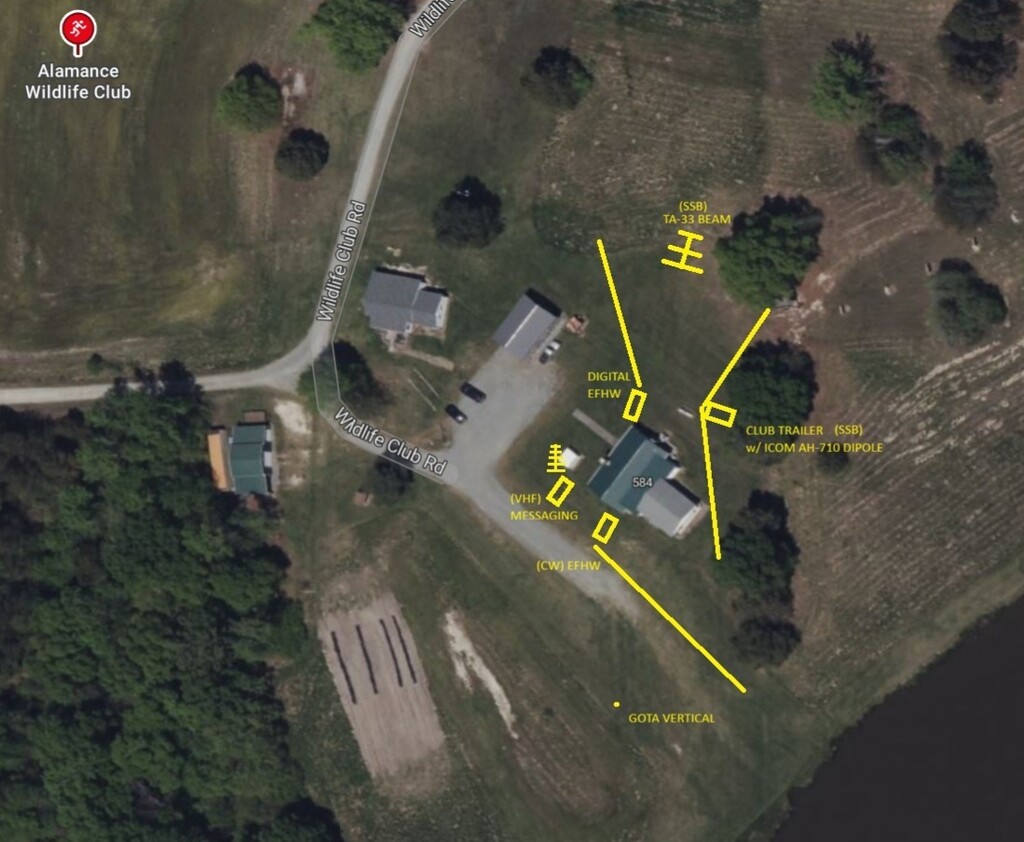
Aerial view of the Alamance Wildlife Club showing proposed Field Day antenna positions: SSB TA-33 beam, club trailer with ICOM AH-710 dipole, digital EFHW, CW EFHW, VHF messaging vertical, and GOTA vertical.
🛰️ Site map coming soon

Aerial view — Alamance Wildlife Club, Wildlife Club Rd

Antennas in the Field

A mix of beams, end-fed wires, and verticals — chosen to give each mode its own quiet patch of spectrum.

  • SSBTA-33 triband beam on a tower
  • SSB · ClubClub trailer with ICOM AH-710 broadband dipole
  • CWEnd-fed half-wave (EFHW) wire
  • DigitalEnd-fed half-wave (EFHW) wire
  • VHFVertical for messaging traffic
  • GOTAVertical near the pond — possible station

Stations on the Air

We're planning to run several simultaneous operating positions — covering voice, code, digital, and VHF — plus a public information table and a station dedicated to first-time operators.

Phone

SSB Voice

TA-33 Triband Beam

Single-sideband voice contacts on 20m, 15m, and 10m. The TA-33 beam gives us directionality to chase rare states and far-flung clubs.

CW

Morse Code

EFHW Wire Antenna

Pure Morse code on the low bands. Worth double points per QSO under the Field Day rules — and a treat to listen to.

Digital

Digital Modes

EFHW Wire Antenna

FT8, FT4, and other digital modes. Quiet, fast, and great for working stations that are too weak to copy by ear.

VHF

VHF Messaging

Vertical Antenna

VHF station dedicated to messaging traffic — practicing the kinds of nets we'd run during a real emergency activation.

Club Trailer

Club Trailer SSB

ICOM AH-710 Dipole

Our portable club trailer brings a second voice station to the field, with ICOM's broadband dipole hung between the trees.

Public

Information Table

Visitor Hub

Brochures, license-class info, repeater details, and friendly hams ready to answer questions. The first stop for visitors.

Tentative · Get on the Air

GOTA Station

Vertical Antenna · Near the Pond

GOTA stands for Get On The Air. It's a Field Day–specific position designed for unlicensed visitors, brand-new hams, and anyone who hasn't been on HF before. With a Control Operator alongside you, you can pick up the microphone and make a real radio contact — no license required for the moment you key up. We're planning to run a GOTA station this year if conditions allow.

Where to Find Us

Alamance Wildlife Club

Wildlife Club Rd · Burlington / Alamance County, NC

👨‍👩‍👧 Bring the Family

Kids welcome. There's plenty to see — beam antennas, generators, headphones to listen on, and operators happy to explain what's happening.

📻 No License Required to Visit

You don't need a callsign to come watch, ask questions, or talk to our operators. If we run a GOTA station, you can even key up under a Control Operator's supervision.

☀️ Rain or Shine

Field Day happens in the elements. We operate from tents, trucks, and trailers regardless of weather. Bring sunscreen Saturday and a jacket Sunday morning.

🅿️ Easy Parking

The Wildlife Club site has open grass parking near the clubhouse. Look for the K4EG signs once you turn onto Wildlife Club Rd.

Help Us Pull It Off

Field Day is a team event. Whether you can swing a coax connector, bake brownies, log contacts, or just keep an extra pair of eyes on the antennas, we have a job for you.

Setup Saturday Morning
2 PM Sat Operating Begins
Overnight Ops Rotate in Shifts
2 PM Sun Wrap & Teardown
Get Updates on groups.io ↗ Sign Up to Help

Field Day at a Glance

24 hrs
Continuous Operation
5+
Operating Positions
HF · VHF
Bands & Modes
1967
AARC Founded

Field Day FAQ

Do I need an amateur radio license to visit?

No. Visitors are welcome regardless of license status. Come watch, listen, and ask questions. If we run a GOTA station, you may even be able to make a contact yourself under a Control Operator's supervision.

What's the address?

The Alamance Wildlife Club, Wildlife Club Rd, Burlington / Alamance County, NC. Look for K4EG signs at the turn. Open in Google Maps ↗.

When are the best times to drop by?

Daylight Saturday through Sunday morning. Setup begins Saturday morning, operating starts at 2:00 PM Saturday, and we operate continuously through 2:00 PM Sunday. Mid-Saturday afternoon and Sunday morning tend to be the most welcoming times for visitors.

What can my kids do there?

Plenty. They can see real beam antennas being aimed, listen on headphones to operators in other states, watch Morse code being sent live, and visit the public information table. We try to make it kid-friendly.

Can I bring a chair, water, snacks?

Absolutely. You're welcome to set up a folding chair near the operating positions and stay as long as you like. Bring water — June in Alamance County can be hot.

What if I want to operate?

Licensed hams who'd like to take a shift at one of our stations should reach out to the club ahead of time so we can put you on the schedule. Use the Contact page or message us through groups.io.

How do I become a licensed ham?

The Technician class license is the entry point and only requires a 35-question multiple-choice exam — no Morse code required. The Resources page on our site has study materials and links to free practice exams.

What if it rains?

We operate rain or shine. Stations are sheltered under tents, in the club trailer, and inside the Wildlife Club building. Visitors are welcome regardless of weather.

June 27 – 28, 2026

Field Day is one of the best ways to experience amateur radio in person — at no cost, with no license required. Come find us at the Alamance Wildlife Club.